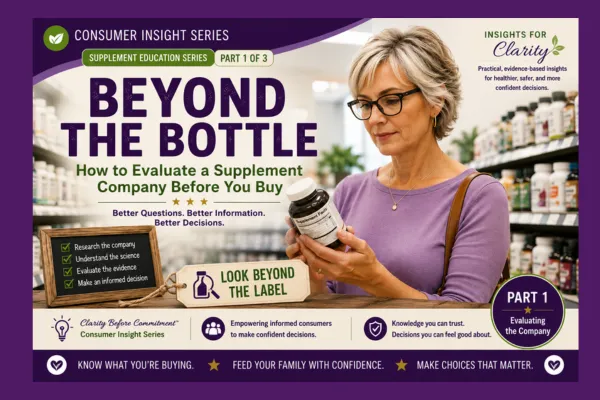
Beyond the Bottle: How to Evaluate a Supplement Company Before You Buy (Pt 1 of 3)
Introduction
Walk through almost any pharmacy, grocery store, warehouse club, or health food store, and you'll find shelves filled with dietary supplements.
Many promise to support heart health, immune function, energy, sleep, digestion, joint comfort, healthy aging, and countless other aspects of wellness. Some bottles are inexpensive. Others cost considerably more. Many make similar claims, yet they can vary dramatically in price, ingredients, and reputation.
So how do you decide which one deserves your trust?
For many consumers, the decision begins with the front of the bottle. A familiar brand name, an attractive label, a recommendation from someone they trust, or a bold marketing claim often becomes the deciding factor.
Those are understandable places to start - but they may not be the best places to stop.
Long before a supplement ever reaches a store shelf or arrives at your front door, hundreds of decisions have already been made. Decisions about scientific research, ingredient sourcing, manufacturing, quality systems, testing, packaging, distribution, customer education, and continuous improvement all happen behind the scenes.
Those decisions are made by people - and by the company behind the product. Most consumers never see that part of the story.
Yet understanding how a company operates can often provide just as much insight as reading the Supplement Facts panel on the bottle.
Throughout decades of experience in risk management, business continuity, and crisis management, one principle consistently proved true:
➡️ Confidence rarely comes from having all the answers. It comes from asking better questions before making an important decision.
That is the purpose of this article.
This isn't about telling you which supplement company is "best," nor is it about criticizing companies for earning a profit. Successful businesses should earn a profit. Profit allows companies to hire talented employees, invest in research and development, improve manufacturing, provide customer service, and continue innovating.
The more meaningful question is how a company earns your trust.
🤔 Does it invest in science?
🤔 Is it transparent about how products are developed?
🤔 How seriously does it approach quality?
🤔 How does it respond when new information becomes available?
Those are the kinds of questions that often matter long after the purchase has been made.
The goal of this article is not to make your decision for you. The goal is to provide a practical framework for evaluating the company behind the bottle so you can make more informed, confident decisions for yourself.
Why? That's simply because better questions often lead to better decisions.
Don't Start with the Supplement. Start with the Company.
When comparing supplements, it's natural to focus on what's easiest to see.
🤔 How much Vitamin C (or other ingredient) does it contain?
🤔 How many capsules are in the bottle?
🤔 How much does it cost?
🤔 Does it contain another particular ingredient you've heard about?
Those comparisons have value, but they only tell part of the story.
Consider other important purchases in life.
Most people wouldn't buy a vehicle without knowing something about the manufacturer. They wouldn't hire a contractor without researching the company, or choose a financial advisor without learning something about the organization behind the recommendations.
Yet many consumers purchase supplements after comparing only the front label, the ingredient list, and the price.
A supplement doesn't simply appear on a shelf. Behind every bottle are decisions about formulation, ingredient sourcing, manufacturing, quality control, scientific research, testing, packaging, storage, and distribution.
Two products may list similar ingredients while the companies behind them operate very differently.
One company may invest heavily in scientific research and product development. Another may focus primarily on marketing and branding. One may own and oversee its manufacturing operations, while another relies entirely on outside manufacturers. Neither business model automatically determines whether a product is right for you, but understanding how a company operates provides valuable context that the label alone cannot.
Before asking, "What's in this bottle?" Consider asking a different question: "Who is behind this bottle?"
That single question can often lead to a much better understanding of the product you're evaluating.

Who Recommended It - and Why?
Most people don't discover a supplement they are seriously considering by accident. Someone recommends it.
That recommendation may come from a physician, pharmacist, registered dietitian, chiropractor, nutrition professional, health coach, family member, friend, or someone they follow online.
Recommendations can be extremely valuable. They often reflect years of education, professional experience, personal use, or positive results observed in others.
However, one of the most important questions isn't simply who made the recommendation.
It's why they made it.
🤔 What influenced their confidence in that particular company or product?
🤔 Was it scientific research? Clinical experience? Personal results?
🤔 The company's reputation? Its manufacturing standards? Its commitment to quality? (And did they share all the details of these with you?)
🤔 Or was it simply the product they were most familiar with? (or that they get paid for recommending?) Getting paid on it is FINE - as long as it really is the right product that has all the right answers to the other questions)
It's also important to recognize that every recommendation is shaped by the knowledge and experience of the person making it. No healthcare professional, educator, or wellness expert can realistically know every supplement company, every manufacturing process, or every formulation available today.
That doesn't make a recommendation less valuable. It simply means a recommendation should often be viewed as the beginning of your research - not the end of it.
The same principle applies to companies.
Every company hopes consumers will choose its products. There is nothing inherently wrong with that. Businesses exist to create value, serve customers, and earn a profit by doing so.
The important question is whether the recommendations being made are supported by credible science, meaningful research, transparent business practices, and a genuine commitment to product quality.
When evaluating a recommendation, consider looking beyond the conclusion and understanding the reasoning behind it.
A recommendation supported by evidence, transparency, and accountability will often provide greater confidence than one supported only by marketing.
What Do You Actually Know About the 'Actual' Company?
Once you've decided to look beyond the bottle, the next step is surprisingly simple:
Learn about the company itself. Now I don't mean only the 'brand name' (for example, Burt's Bees is actually owned by Clorox), so you should be looking at Clorox in that case.
Many consumers spend more time researching a new television, reading hotel reviews, or comparing restaurants than they do learning about the company behind a supplement they may take every day.
Fortunately, much of the information needed to begin that evaluation is publicly available. Start with the company's own website.
🤔 Does it clearly explain its mission, history, and values? If you are looking at the 'brand' (example: Burt's Bees), does it clearly show who REALLY is behind it and owns it (like Clorox), or does it hide that?
🤔 Does it provide meaningful information about its scientific team, manufacturing practices, research, quality standards, and where (at least what country) its manufacturing plants are in that you make the product you would be purchasing?
🤔 Or is the website focused almost entirely on marketing claims?
Transparency doesn't guarantee quality, but companies that openly explain how they operate often make it easier for consumers to evaluate them.
Another important consideration is accessibility.
If you have a question about an ingredient, a manufacturing process, or a claim made about a product, can you actually get an answer?
Some companies make it easy to speak with knowledgeable actual company representatives (I did not say 'distributor'... I said Actual Company Employees) who can explain their products, quality standards, or manufacturing practices. Others may limit communication to online forms, automated responses, or general customer service channels that are unable to answer more detailed questions.
No company can have every employee answer every scientific question, and not every employee will have the same level of expertise. However, companies that make knowledgeable people available and encourage open communication often demonstrate a commitment to educating consumers rather than simply marketing to them.
It's also worth considering whether someone within the organization can stand behind the information being shared. Being able to reach a knowledgeable person who is responsible for the accuracy of the information they provide can inspire greater confidence than receiving a generic response that doesn't address the question being asked.
Ultimately, trust is built through more than products. It is built through communication, transparency, accountability, and a willingness to help consumers make informed decisions.
4. Who Actually Manufactures the Product?
One of the biggest misconceptions about dietary supplements is that the company whose name appears on the label is always the company that manufactures the product.
In reality, that isn't always the case.
Within the supplement industry, companies generally use one of three manufacturing models.
👉 Some own and operate their own manufacturing facilities.
👉 Others partner with independent contract manufacturers that produce products to their specifications.
👉 Still others sell products manufactured by another company under their own brand name, often referred to as private-label manufacturing.
None of these approaches automatically determines whether a product is high quality. Excellent products can be produced under each model.
However, understanding who is responsible for manufacturing can provide valuable insight into how a company operates.
When a company owns and operates its own manufacturing facilities, it typically has direct oversight of the people, equipment, processes, and quality systems involved in production. Research scientists, engineers, quality assurance teams, maintenance personnel, and production staff all work toward the same organizational standards and objectives.
That level of integration can make it easier to implement improvements, maintain consistency, investigate concerns, and continuously refine manufacturing processes over time.
Of course, ownership alone doesn't guarantee excellence. What matters is how that responsibility is exercised.
🤔 Does the company invest in modern facilities?
🤔 Does it continually improve its manufacturing processes?
🤔 Does it maintain rigorous quality standards?
🤔 Does it view quality as an ongoing commitment rather than a one-time achievement?
Companies that use contract manufacturers can also produce exceptional products. Many establish detailed manufacturing specifications, conduct facility audits, require extensive ingredient testing, and maintain strict quality control before products are released.
The manufacturing model itself isn't the most important question. The more meaningful question is whether the company demonstrates a clear commitment to quality, accountability, and continuous improvement throughout the manufacturing process.
Understanding who manufactures the product simply provides another piece of that larger picture.

Follow the Evidence, Not the Advertising
Every company wants consumers to understand the value of its products. There's nothing wrong with that.
Marketing plays an important role in introducing products, educating consumers, and explaining why a company believes its products deserve consideration.
The more important question is whether those messages are supported by 'current' meaningful evidence. Just because something was cutting edge or great 20 or 30 years ago doesn't automatically mean it is the best on the market today.
Companies that prioritize scientific research often invest heavily in research teams, laboratories, product development, manufacturing innovation, and ongoing scientific evaluation. Others may devote a greater share of their resources to branding, advertising, packaging, or influencer marketing.
Neither approach automatically determines the quality of a product. The key is whether the company's claims are supported by credible evidence rather than persuasive marketing alone.
One place to begin is by looking at the people behind the science.
🤔 Does the company employ qualified scientists or researchers?
🤔 Does it have scientific advisors with relevant expertise?
🤔 Does it explain how products are developed and evaluated?
🤔 Is there evidence that the company continues to invest in research and innovation over time?
Consumers may also encounter references to patents. A patent does not prove that a product is better than every alternative, nor does the absence of a patent indicate that a product lacks quality.
However, patents can demonstrate that a company has invested significant time and resources into developing a novel invention, formulation, process, or technology that met the legal requirements for patent protection.
They are one indicator of innovation - not proof of superiority.
Clinical research deserves the same thoughtful evaluation. Not all studies answer the same questions.
For example, research conducted on an individual ingredient is different from research evaluating the finished product consumers actually purchase. Likewise, studies that include significant changes in diet, exercise, or other lifestyle factors may provide valuable information, but those additional changes can make it more difficult to determine which factors contributed to the results.
Rather than simply asking whether a study exists, consider asking what the study was designed to evaluate.
🤔 Was the finished product studied?
🤔 Were appropriate comparison methods used?
🤔 Was the research published in a peer-reviewed scientific journal?
🤔 Do the study's conclusions reasonably support the claims being made?
Innovation should also be viewed through a practical lens. New technologies, improved delivery systems, and advances in manufacturing can provide meaningful benefits when they improve quality, consistency, or product performance.
The goal of innovation, however, shouldn't simply be to make products more expensive. It should create meaningful value for the consumer.
In the end, marketing may introduce a product. Evidence is what helps earn confidence.
Another piece to look at is awards, especially those that are independent, not applied for by the company, and those from both trusted sources and actual consumers. Look to see if the parent company has recent awards listed that can be verified by independent sources, not only from the company's website.
How Does the Company Respond When New Information Emerges?
Science is continually evolving. Researchers learn more. Manufacturing processes improve. New technologies become available.
Sometimes, ingredients or manufacturing practices that were once widely accepted are later re-evaluated as additional evidence becomes available.
One of the most revealing characteristics of a company isn't whether questions ever arise. It's how the company responds when they do.
History offers many examples of products and ingredients that have been re-examined as scientific understanding evolved. In some cases, companies voluntarily reformulated products or adopted new manufacturing practices before regulations required them to do so. Others waited until additional evidence emerged or regulatory agencies updated their guidance.
Those decisions often involve complex scientific, operational, financial, and regulatory considerations.
The purpose here isn't to suggest that one approach is always right and another is always wrong. Instead, it's worth considering what those decisions reveal about a company's overall philosophy.
👉 Does the company actively monitor emerging scientific information?
👉 Does it invest in improving products over time?
👉 Does it explain why changes were made?
👉 Does it openly communicate with consumers when questions arise?
Transparency isn't demonstrated only when everything goes well. It is often demonstrated most clearly when companies face uncertainty.
Consumers don't expect organizations to predict every future discovery or eliminate every possible challenge. They do expect companies to approach those challenges thoughtfully, communicate honestly, and continually work to improve.
Ultimately, trust is rarely built because an organization never encounters questions or obstacles. Trust is built through preparation, accountability, continuous improvement, and a willingness to earn confidence over time.
Those principles extend well beyond dietary supplements. They are characteristics that consumers can use to evaluate almost any company, product, or service.
Conclusion
Choosing a dietary supplement isn't simply about comparing labels or finding the lowest price. It's about deciding which companies have earned your confidence through their commitment to quality, transparency, research, and continuous improvement.
No single question can tell you whether a supplement company is right for you. Instead, confidence comes from looking beyond the bottle and evaluating the bigger picture.
🤔 Who is behind the product?
🤔 How is it manufactured?
🤔 What evidence supports the claims being made?
🤔 How openly does the company communicate?
🤔 How does it respond as new information becomes available?
These aren't questions designed to eliminate every uncertainty. Rather, they help you make more informed decisions based on the information available today.
The purpose of this article has never been to recommend one company over another. It has been to encourage a different way of thinking.
Why? Simple - because confident consumers aren't the ones who know every answer. They're the ones who know how to ask better questions. And better questions often lead to better decisions.
Coming in Part 2
In this article, we've focused on evaluating the company behind the bottle.
Next, we'll turn our attention to the product itself.
Many supplement labels appear straightforward at first glance, but they often contain information that can be difficult to interpret without understanding what you're looking at.
In Part 2: Evaluating the Supplement Itself, we'll explore questions such as:
What does the Supplement Facts panel really tell you?
What are proprietary blends, and when should you pay attention to them?
Are more ingredients always better?
What do "other ingredients" actually do?
How can you compare two products that appear similar?
What information isn't required to appear on the label?
By the end of Part 2, you'll have a practical framework for evaluating the product itself—so you can look beyond marketing claims and better understand what's actually in the bottle. (And yes, there is also a Part 3!)
Continue the Conversation
Have you ever researched a supplement company before making a purchase?
What factors give you confidence in a product or the company behind it?
Was there a question in this article that you've never considered before?
Share your thoughts or experiences in the comments below. Your perspective may help someone else become a more informed and confident consumer.
Key Takeaways
The company behind a supplement can be just as important as the ingredients inside the bottle.
Recommendations are valuable, but understanding why a product is recommended can provide additional insight.
Learning about a company's research, manufacturing, quality standards, and transparency can help you make more informed decisions.
Different manufacturing models can all produce quality products, but understanding who is responsible for manufacturing provides valuable context.
Marketing introduces products. Evidence helps build confidence.
Companies that communicate openly and continually improve often demonstrate a long-term commitment to earning consumer trust.
Better decisions don't require knowing every answer - they begin with asking better questions.
Frequently Asked Questions
1. How do I know if a supplement company is trustworthy?
Look beyond the label. Consider the company's history, manufacturing practices, commitment to research, transparency, quality standards, and willingness to answer consumer questions.
2. Does a higher-priced supplement always mean better quality?
No. Price alone doesn't determine quality. Higher costs may reflect research, ingredient sourcing, manufacturing processes, or marketing. Evaluating the company behind the product provides more meaningful information than price by itself.
3. Is it better if a company manufactures its own supplements?
Not necessarily. Companies that own their manufacturing facilities may have greater oversight and control, while many contract manufacturers also produce high-quality products. What's most important is the company's commitment to quality systems and continuous improvement.
4. What should I look for when researching a supplement company?
Look for information about its history, scientific expertise, manufacturing practices, quality standards, transparency, customer education, and commitment to ongoing research and improvement.
5. Can I trust recommendations from doctors, friends, or influencers?
Recommendations can be valuable starting points, but they shouldn't replace your own research and definitely shouldn't be the ONLY deciding factor. Understanding why a product is recommended can help you make a more informed decision.
6. Does a patented ingredient mean a supplement is better?
Not automatically; however, understanding what it takes to get a patent IS important. Many companies say they choose not to get a patent because of cost - and the reality is they don't want to pay the cost and KNOW they will be turned down. Patents may indicate innovation or a novel process, but they don't guarantee that one product is superior to every alternative.
7. Why does scientific research matter when evaluating supplements?
Scientific research helps determine whether product claims are supported by evidence. It's also important to understand what the research actually studied, whether it involved an ingredient or the finished product, and how the study was conducted.
8. Should I be concerned if a company changes its formula?
Not necessarily. Companies may reformulate products for many reasons, including new scientific evidence, ingredient availability, manufacturing improvements, or regulatory updates. Understanding WHY changes were made and actually WHAT changed will provide valuable insight.
9. Why is transparency important when choosing a supplement company?
Transparent companies make it easier for consumers to understand how products are developed, manufactured, tested, and improved. Openness can help consumers make more informed decisions.
10. Why is it important to evaluate the company instead of only the supplement?
The supplement is the final product of hundreds of decisions made by the company - from research and ingredient sourcing to manufacturing, quality control, and customer education. Evaluating those decisions provides a more complete picture than the label alone.


