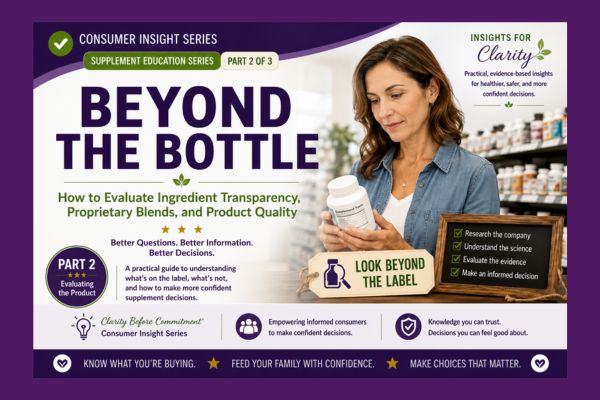
Beyond the Bottle: How to Evaluate a Supplement Before You Buy (Pt 2 of 3)
If You Missed Part 1...
In Part 1of this three-part series, we focused on evaluating the company behind a supplement. We explored why manufacturing standards, ingredient sourcing, scientific research, quality control, transparency, and regulatory compliance all matter when deciding whether a brand deserves your trust. If you haven't read it yet, I encourage you to start there. Understanding the company provides an important foundation for evaluating the supplement itself.
Introduction
Walk into almost any pharmacy, grocery store, warehouse club, or health food store and you'll find shelves filled with supplements that all promise to support better health.
Browse online, and the choices become even more overwhelming.
One product advertises "maximum strength." Another claims to be "doctor formulated." Others highlight words like premium, natural, clinically studied, or advanced formula. The labels are colorful, the marketing is persuasive, and many products appear remarkably similar.
AND... appearances can be deceiving.
Two supplements sitting side by side may contain the same nutrient, yet differ significantly in the form of that nutrient, the amount provided, the quality of the ingredients, the supporting research, and even how well your body is able to absorb and use it.
That's why choosing a supplement isn't simply about finding a trusted company or selecting the bottle with the most impressive marketing claims.
It's also about learning how to evaluate the product itself. The good news is that you don't need a degree in nutrition, chemistry, or medicine to become a more informed consumer.
You simply need to know where to look, what questions to ask, and how to separate meaningful information from marketing.
In this article, we'll explore the practical framework I use when evaluating supplements. You'll learn how to read a Supplement Facts panel, understand why the form of a nutrient matters, recognize common marketing tactics, evaluate ingredient quality, and identify factors that can influence a supplement's effectiveness and value.
The goal isn't to tell you which supplement to buy. It's to give you the knowledge and confidence to evaluate supplements for yourself.
Don't Judge a Supplement by Its (Marketing) Label
Imagine buying a car without ever looking under the hood.
You admire the paint color, appreciate the comfortable seats, and like the features highlighted in the advertisement. Everything looks impressive - but you never ask about the engine, the safety ratings, or the reliability of the vehicle.
Most people would agree that wouldn't be a wise purchasing decision. Yet that's often how supplements are evaluated.
Many consumers make a decision based almost entirely on the front of the bottle.
The packaging is attractive. The product has a recognizable name.
The label features impressive claims such as"Maximum Strength," "Premium Formula," "Doctor Developed," or "Clinically Studied."
Some packages emphasize that they're natural, pure, or high potency, while others display large numbers (including x number of 'types' of that supplement) intended to make the product appear more powerful than competing brands.
None of these claims automatically tells you whether the supplement is appropriate for your needs.
Why? Because the front label serves one primary purpose:
😭 It introduces the product and communicates how the manufacturer WANTS consumers to perceive it.
The information you need to make an informed decision is usually found elsewhere.
Instead of asking "What is this bottle promising?"
Begin asking questions like:
What ingredients does this supplement actually contain?
How much of each ingredient am I getting?
What form of each nutrient is being used?
Is there research supporting this formula?
Does this amount appear meaningful?
Are there ingredients that I may not need - or may want to avoid?
Those questions shift your focus from advertising to evidence. And that's where informed decision-making begins.
One of the most valuable habits you can develop as a consumer is learning to pause before purchasing. Instead of allowing the front of the bottle to make the decision for you, use it as an invitation to look deeper.
Again, Why? Simple - because the most important information about a supplement is rarely found on the front label.

The Supplement Facts Panel: Where the Real Story Begins
If the front of the bottle introduces the product, the Supplement Facts panel tells you what's actually inside.
Think of it as the supplement equivalent of a Nutrition Facts label on food. It isn't designed to persuade you.It's designed to provide information.
Learning how to read this panel is one of the most valuable skills you can develop because it allows you to compare products based on facts rather than marketing.
➡️ Start with the Serving Size
One of the easiest mistakes to make is comparing two products without noticing the serving size.
For example, one supplement may provide its listed amounts in one capsule, while another provides its amounts in two capsules, four capsules, or even a scoop of powder.
If you compare only the numbers without considering the serving size, you're not making an apples-to-apples comparison.
Understanding the serving size gives important context to every number that follows.
➡️ Next, Look at the Amount Per Serving
After identifying the serving size, examine the amount of each active ingredient. It's tempting to assume that more is always better.
In reality, that's not necessarily true.
Some nutrients have well-established intake recommendations. Others appear in amounts based on scientific research evaluating specific health outcomes. In some cases, increasing the dose beyond a certain point provides little additional benefit, while in others it may not be appropriate for everyone.
The goal isn't to find the largest number. The goal is to determine whether the amount included is appropriate and supported by evidence. Sometimes a product uses alot of hype words for those ingredients that are publicized, and yet when you look at how much of it is actually IN the product, it's next to nothing.
➡️ Understanding the Daily Value
You'll also notice a column labeled % Daily Value (DV) for many vitamins and minerals.
The Daily Value is intended to provide a general reference for how much one serving contributes toward the recommended daily intake for many healthy adults.
It's a useful guide - but it isn't personalized.
Your nutritional needs may vary based on factors such as age, sex, pregnancy, medical conditions, medications, activity level, dietary patterns, or recommendations from your healthcare provider.
The Daily Value should be viewed as a starting point rather than a one-size-fits-all recommendation.
➡️ Don't Ignore the "Other Ingredients"
Many consumers stop reading after the active ingredients. That's a mistake.
The Other Ingredients section often lists capsule materials, binders, fillers, flow agents, sweeteners, flavors, preservatives, colors, and common allergens. These ingredients don't necessarily make a supplement good or bad; however, they may influence your purchasing decision depending on your personal preferences, dietary restrictions, allergies, sensitivities, or health goals.
We'll discuss these ingredients in more detail later in this article because understanding them is an important part of evaluating the overall quality of a supplement.
The Supplement Facts panel may not be the most exciting part of the label - but it is often the most informative.
Once you learn how to read it, you'll begin comparing supplements based on meaningful information instead of marketing claims.

Why the Form of a Nutrient Matters
Imagine two bottles of magnesium sitting side by side on a store shelf.
Both contain 200 milligrams of magnesium. Both cost about the same. Both promise similar benefits.
At first glance, they appear almost identical. But they may perform very differently in the body.
One might be more readily absorbed and better suited for supporting normal muscle and nerve function, while another may be absorbed differently and commonly used for an entirely different purpose.
The label on the front of the bottle may simply say "Magnesium."
The important information is usually found in much smaller print.
It might say:
Magnesium glycinate
Magnesium citrate
Magnesium malate
Magnesium oxide
Magnesium chloride
Or something different that you have never heard of
Each of these provides magnesium, but they are different chemical forms with different characteristics. They may differ in how well they dissolve, how much elemental magnesium they provide, how they're absorbed, and how they're commonly used in research and clinical practice.
The same principle applies to many other nutrients.
For example:
Vitamin B12 - may be listed as cyanocobalamin or methylcobalamin.
Vitamin K - may appear as vitamin K1 or vitamin K2, with K2 available in different forms such as MK-4 or MK-7.
Folate - may be listed as folic acid or as methylfolate.
Calcium - may be provided as calcium carbonate or calcium citrate.
Iron - comes in several forms, each with different absorption characteristics and tolerability.
Omega-3 supplements - usually contain varying amounts of EPA and DHA, even when the total amount of fish oil appears similar.
This doesn't necessarily mean that one form is always "good" and another is always "bad." Rather, it means that the form of a nutrient can influence how a supplement is absorbed, utilized, tolerated, or studied.
That's one reason comparing supplements based only on the large number displayed on the front of the bottle can be misleading.

Looking Beyond the Milligrams
Many consumers naturally assume that a supplement containing a larger amount of a nutrient must be the better choice.
In reality, quantity tells only part of the story.
Suppose one product advertises 500 mg of calcium, while another provides 300 mg. Without additional information, you can't conclude that the first product is automatically superior.
You would also want to consider questions such as:
Which form of calcium is being used?
How well is that form typically absorbed?
Is the serving size the same?
Does the formula contain nutrients that work together?
Is the amount consistent with how the product is intended to be used?
The same thinking applies across many categories of supplements. Looking beyond the number encourages a more thoughtful comparison.
More Isn't Always Better
Supplement marketing often encourages consumers to focus on larger numbers.
➡️ Higher potency. Maximum strength. Extra strength. Mega dose.
While there are situations where higher amounts may be appropriate, more isn't automatically better.
For some nutrients, the body can absorb only a limited amount at one time. For others, increasing the dose beyond a certain level may not provide additional benefit for most healthy individuals.
In some situations, taking excessive amounts may even increase the risk of unwanted side effects or interactions.
That's one reason it's helpful to evaluate the complete formula rather than focusing on a single number printed on the front of the bottle.
Focus on the Entire Picture
When evaluating a supplement, consider asking yourself:
What form of the nutrient is being used?
Why might the manufacturer have selected that form?
Is the amount supported by research?
Does the formula make sense as a whole?
Is the product designed for my individual needs and health goals?
Those questions won't always produce simple answers. However, they move you beyond marketing and toward evidence-based evaluation - which is exactly the goal of becoming a more informed consumer.
As you continue reading labels, you'll likely notice that the ingredient form often explains differences in price, formulation, and intended use that aren't immediately obvious from the front of the bottle.
Learning to recognize those differences is one of the most valuable skills you can develop when comparing supplements.
Ingredients Beyond the Active Ingredients
By now, you've learned to look beyond the front of the bottle and spend time reading the Supplement Facts panel. That's an important first step - but don't stop there.
One of the most commonly overlooked parts of a supplement label is the section typically found just below the Supplement Facts panel labeled "Other Ingredients."
Many consumers skip over it entirely. Others assume these ingredients don't matter because they aren't the vitamins, minerals, herbs, or other compounds the product is being marketed for.
In reality, these ingredients can provide valuable information about how the supplement is manufactured, delivered, preserved, and consumed. That doesn't mean they're something to fear - it does mean they're worth understanding.
Just as with food labels, becoming familiar with the complete ingredient list allows you to make more informed decisions based on your own preferences, dietary needs, and health considerations.
What Are "Other Ingredients"?
Most supplements contain more than just their active ingredients.
Depending on the product, manufacturers may include additional ingredients that help produce, protect, flavor, stabilize, or deliver the supplement.
These ingredients generally serve a functional purpose rather than being included for the primary health benefit advertised on the label. For example, some ingredients help hold a tablet together during manufacturing. Others improve consistency, protect sensitive ingredients from moisture, enhance flavor, or make capsules easier to swallow.
Without some of these supporting ingredients, many supplements would be difficult to manufacture consistently or maintain their quality throughout their shelf life.
The important point is this: "Other Ingredients" does not automatically mean "unnecessary ingredients."
Instead, it tells you what else is included in the finished product.
Common Types of Other Ingredients
As you begin reading supplement labels, you'll likely notice similar categories appearing repeatedly.
Capsule Materials
Many supplements are delivered in capsules rather than tablets. The capsule itself is an ingredient.Some capsules are made from gelatin, while others use plant-based materials such as cellulose or hypromellose. Depending on your dietary preferences or lifestyle, this may be information you want to consider.
Binders
Binders help hold ingredients together, particularly in tablets. Without them, a tablet could easily crumble during manufacturing, shipping, or storage.
Flow Agents
Powdered ingredients don't always move smoothly through manufacturing equipment. Flow agents help ingredients move consistently during production, allowing manufacturers to produce products with greater uniformity.
Coatings
Some tablets include coatings that make them easier to swallow, help protect ingredients from moisture, or improve stability during storage.
Sweeteners and Flavors
Chewable tablets, gummies, powders, and liquid supplements often contain sweeteners or flavoring ingredients to improve taste. Consumers who prefer to avoid certain sweeteners or artificial flavors may wish to review this section carefully.
Colors
Some supplements contain coloring ingredients to improve appearance or create brand consistency. Others contain no added colors at all. Again, this isn't necessarily good or bad - it simply becomes part of your overall evaluation.
Allergens
Many manufacturers also identify common allergens, such as soy, milk, wheat, eggs, shellfish, peanuts, tree nuts, or sesame, either within the ingredient list or in a separate allergen statement.
For individuals with food allergies or sensitivities, this information may be particularly important.
Reading the Entire Label Tells a More Complete Story
Imagine comparing two supplements that appear nearly identical from the front of the bottle.
The active ingredients are similar. The dosage is similar. Even the price is similar.
But one product contains several artificial colors, multiple sweeteners, and ingredients you personally prefer to avoid. The other uses a simpler formulation that better aligns with your individual preferences.
Without reading the entire label, you would never know there was a difference. That's one reason informed consumers develop the habit of reading beyond the Supplement Facts panel.
Sometimes the details that influence your purchasing decision aren't found in the headline ingredients - they're found in the supporting ingredients.
Understanding Without Creating Fear
It's easy to find articles online that portray every unfamiliar ingredient as something dangerous.
That's rarely a balanced or evidence-based approach. The fact that an ingredient has a long scientific name doesn't automatically mean it's harmful. Likewise, the fact that an ingredient sounds "natural" doesn't automatically make it safer or more appropriate.
Context matters.
Every ingredient should be evaluated based on its purpose, the available scientific evidence, regulatory requirements, and your own individual circumstances. The goal isn't to become suspicious of every ingredient you can't pronounce - it's simply to become familiar enough with supplement labels that you understand what you're purchasing.
A Simple Habit That Can Improve Your Decisions
The next time you pick up a supplement, resist the temptation to stop reading after the active ingredients.
Instead, take an extra minute to review the complete ingredient list.
Ask yourself:
What purpose might these additional ingredients serve?
Do any ingredients stand out because of my dietary preferences or allergies?
Is there anything I'd like to learn more about before purchasing?
You don't need to research every ingredient every time you shop. But - developing the habit of reading the entire label can help you become a more informed consumer over time.
And that's really the goal of this series - not to create fear or tell you what to buy, but to give you the knowledge and confidence to ask better questions before making your decisions.

Proprietary Blends: What They Are - and What They Don't Tell You
As you become more comfortable reading Supplement Facts panels, you may come across a heading that says something like "Proprietary Blend," "Proprietary Formula," or "Proprietary Matrix."
For many consumers, those words sound impressive. After all, proprietary suggests something unique, exclusive, or specially developed.
But what does it actually mean?
A proprietary blend is a combination of ingredients grouped together under one name, with only the total amount of the entire blend listed on the label.
The individual ingredients are typically listed in descending order by weight, but the exact amount of each ingredient is not disclosed.
For example, a label might say:
Performance Blend – 500 mg
Containing:
Green Tea Extract
Rhodiola
Turmeric
Ginseng
Black Pepper Extract
What the label doesn't tell you is how much of each ingredient makes up that 500-milligram total. One ingredient could account for most of the blend, while another may be present in a much smaller amount. Without additional information, there's no way to know from the label alone.
That doesn't automatically make the product good or bad - it simply means the label provides less detail for comparison.
Why Do Companies Use Proprietary Blends?
There are legitimate reasons a manufacturer may choose to use a proprietary blend.
Developing a new supplement isn't always as simple as combining a few ingredients. Some companies invest years researching formulations, evaluating ingredient combinations, conducting stability testing, and in some cases performing clinical research on their finished products. Protecting that work from being easily copied by competitors is one reason companies may choose to keep certain formulations confidential.
Just as pharmaceutical companies, technology companies, and medical device manufacturers protect innovations through patents and other forms of intellectual property, supplement companies may also develop proprietary ingredients, patented ingredients, trademarked ingredients, or unique formulations.
Protecting intellectual property is a normal part of many industries. It doesn't automatically mean the product is superior. And it certainly doesn't mean it's inferior.
It's simply one piece of information to consider when evaluating the product.
What Information Isn't Provided?
When individual ingredient amounts aren't listed, it becomes more difficult for consumers to compare products or relate a formula to available scientific research.
Many published studies evaluate ingredients at specific amounts. If a proprietary blend doesn't disclose the amount of each ingredient, it can be difficult to determine how closely the product resembles the formulas evaluated in published research.
That doesn't mean the product won't be effective. It simply means you have less information available for comparison.
Consumers who prefer complete transparency may appreciate products that disclose the amount of every ingredient individually. And, sometimes, that means they may lose out on the most effective product simply because of disclosure.
Others may be comfortable evaluating the product using additional information provided by the manufacturer.
Neither approach is automatically right or wrong. The important thing is understanding what information the label does - and does not - provide.
Proprietary Doesn't Automatically Mean Inferior
One of the biggest misconceptions is that a proprietary ingredient or proprietary blend is automatically something to avoid.
That's simply not a conclusion you can reach based on the label alone. Some proprietary ingredients have been extensively researched and may even be protected by patents or trademarks because of the investment required to develop them.
Others may have little publicly available research.
The key point is that "proprietary" describes how information is presented or protected - it does not, by itself, tell you anything about the quality, safety, or effectiveness of the ingredient.
As with every other part of evaluating a supplement, context matters.
Don't Let One Rating Make the Decision for You
Today, many consumers use apps and websites to evaluate supplements, foods, cosmetics, and household products.
These resources can be helpful starting points, but they shouldn't become the only basis for an important purchasing decision.
There are several reasons why.
🔥 First, every rating system uses its own methodology.
One app may emphasize ingredient transparency. Another may focus on specific ingredients. Another may prioritize environmental considerations, certifications, or other evaluation criteria.
As a result, it's entirely possible for the same product to receive very different ratings across different platforms.
🔥 Second, many online platforms generate revenue in different ways.
Depending on the platform, this may include advertising, affiliate commissions, sponsored content, premium listings, or business partnerships. Understanding how a platform operates can provide valuable context when interpreting its recommendations and ratings.
🔥 Finally, no app can replace critical thinking.
A numerical score rarely tells the complete story.
• It doesn't explain the company's manufacturing standards.
• It doesn't describe the scientific research supporting the finished product.
• It doesn't tell you whether a patented ingredient has been clinically studied.
• And it doesn't determine whether a supplement is appropriate for your individual needs.
Rather than relying on a single rating—or dismissing a product because one app scores it differently than another—consider using ratings asone piece of a much larger evaluation process.
➡️ Read the label.
➡️ Understand the ingredients.
➡️ Review the available research.
➡️ Learn about the manufacturer.
➡️ Compare multiple sources.
Then make an informed decision based on the totality of the evidence.
Confidence Comes From Understanding
One of the themes throughout this series is that better decisions often begin with better questions.
A proprietary blend isn't automatically a positive feature. It isn't automatically a negative feature either. A patented ingredient isn't automatically superior. And a low - or high - rating from a single app doesn't automatically tell the entire story.
Every supplement should be evaluated as a whole.
The more you understand how labels are organized, why companies protect intellectual property, and how different information sources arrive at their conclusions, the more confident you'll become in evaluating products for yourself.
Why? Thaty's simple - because the goal isn't to find someone else to make your decisions. The goal is to become an informed consumer who understands how to evaluate the information before deciding what to believe.

Quality, Purity, and Testing: Looking Beyond the Ingredient List
Choosing a supplement isn't just about what ingredients appear on the label.
It's also about whether those ingredients are actually present in the finished product, whether they're manufactured consistently, and whether the company has processes in place to help ensure quality from one batch to the next.
A supplement label tells you what the manufacturer included in the bottle at the time it was made. Quality systems help determine whether those are accurate and safe.
Why Manufacturing Matters
Imagine two companies using the exact same ingredient list.
On paper, the products appear identical.
But what happens behind the scenes may be very different.
Questions worth considering include:
Where are the ingredients sourced?
How are they identified before manufacturing?
Are raw materials tested before production?
Are products tested during manufacturing?
Is the finished product tested before it's released?
How are quality issues investigated if they occur?
These aren't questions most consumers think to ask. Many people 'assume' the answer is yes as the government allows that company to sell the product. And, in many times that is not a good assumption. They can be just as important as the ingredient list itself.
Understanding Good Manufacturing Practices (GMPs)
In the United States, dietary supplement manufacturers are required to follow Current Good Manufacturing Practices (cGMPs) established by the FDA. These regulations are intended to help ensure supplements are manufactured under controlled conditions and that companies have systems in place for quality, identity, purity, strength, and composition.
However, it's important to understand what cGMP compliance does - and does not - mean.
Following cGMP requirements doesn't automatically mean every supplement on the market is identical in quality.
Companies can still differ significantly in areas such as:
Ingredient sourcing
Manufacturing technology
Testing procedures
Quality standards beyond regulatory minimums
Investment in research and quality systems
Meeting regulatory requirements is important. And, some companies also choose to implement additional quality measures beyond those minimum standards. Knowing who does the minimum only and who does more is important.
Third-Party Testing: What Does It Mean?
You may also see companies advertise that their products are "third-party tested."
Generally, this means a 3rd laboratory has performed specific testing on the product or ingredients. (And it should also be noted that this alone doesn't mean an INDEPENDENT 3rd party has done 'BLIND' testing. Those are 2 different things).
Depending on the company, testing may evaluate things such as:
Identity
Purity
Potency
Microbial contamination
Heavy metals
Other quality specifications
However, not every third-party certification evaluates the same things. Different organizations have different testing protocols and certification standards.
Seeing a third-party seal can provide additional information, but it's still worth understanding what was actually tested rather than assuming every certification means the same thing. And, if it truly was an Independent Blind test (or not).
What does Blind testing mean? It means that although the manufacturer paid for the testing, the lab that is doing the testing has no idea WHO that manufacturer actually is.
Transparency Builds Confidence
One characteristic many consumers appreciate is transparency.
• Can the company explain where its ingredients come from?
• Does it describe its manufacturing process?
• Does it answer technical questions?
• Does it provide educational resources instead of simply making marketing claims?
Companies that openly discuss their quality systems often make it easier for consumers to evaluate the information they're providing. Transparency doesn't guarantee a product is the best choice for everyone - but it can help consumers ask better questions and make more informed comparisons.
Quality Is More Than a Marketing Claim
Words such as these often appear on supplement packaging:
Premium
Pure
Pharmaceutical Grade
Clinically Formulated
Scientifically Advanced
While these phrases may describe aspects of a product, they are NOT all standardized regulatory terms.
Rather than relying on marketing language alone, consider asking:
What evidence supports these claims?
Does the company explain what these terms mean?
Can the manufacturer provide additional information if requested?
Is there research supporting the finished product or only individual ingredients?
Good questions often provide more useful answers than impressive-sounding labels.
Looking at the Whole Picture
No single factor determines supplement quality.
Not the ingredient list. Not the front label. Not a proprietary blend. Not one certification. Not one app.
Instead, think of supplement evaluation as putting together pieces of a puzzle. Each piece provides additional information.
When you consider ingredient quality, manufacturing practices, transparency, available research, and the company's willingness to answer questions, you begin developing a much more complete picture of the product you're evaluating.
That's exactly what informed consumers do. They don't rely on one claim. They look at the whole picture before making a decision.

Putting It All Together: A Smarter Way to Evaluate Supplements
By now, you've probably realized there isn't a single question that determines whether a supplement is worth purchasing.
No one ingredient. No one certification. No one app. No one expert. And no single marketing claim.
Instead, evaluating a supplement is about looking at the entire picture.
That's true whether you're considering a multivitamin, protein powder, omega-3, probiotic, collagen product, or any other dietary supplement.
Every piece of information contributes to a more complete understanding of the product you're evaluating.
Think Like an Informed Consumer
Many purchasing decisions happen quickly.
👉 We see an advertisement.
👉 A friend recommends a product.
👉 An influencer posts a video.
👉 A rating app gives it five stars.
👉 The label promises amazing results.
It's easy to assume one of those pieces of information is enough. But informed consumers recognize that every source has limitations.
Instead of asking, "Should I buy this?" try asking, "What information do I still need before I decide?"
That simple shift often leads to much better decisions.
A Practical Evaluation Checklist
The next time you're considering a supplement, ask yourself questions like these:
About the Company
Is the manufacturer transparent about who they are?
Do they explain how their products are made?
Can I easily find educational information beyond marketing claims?
About the Product
Can I understand the Supplement Facts panel?
Are ingredient forms clearly identified?
Are "Other Ingredients" disclosed?
If the formula is proprietary, do I understand what information is—and isn't—available?
About Quality
Does the company discuss manufacturing standards?
Is testing explained?
Is there information about ingredient sourcing or quality control?
About the Science
Is there research supporting the finished product or only individual ingredients?
Are references available?
Does the information appear balanced and evidence-based?
About the Information I'm Using
Am I relying on one app or one review?
Have I compared multiple sources?
Do I understand why different sources may reach different conclusions?
You don't have to know every scientific detail.
You simply want enough reliable information to feel confident in your decision.
Progress Over Perfection
One of the biggest misconceptions about becoming an informed consumer is believing you need to become an expert before making good decisions.
You don't.
You simply need to become more curious.
• Every label you read.
• Every question you ask.
• Every article you compare.
• Every conversation you have with a knowledgeable professional.
All of those experiences build your confidence over time. Nobody starts out knowing everything about nutrition, manufacturing, or scientific research.
Learning is a process. And....each better question brings you one step closer to making more informed decisions.
The Goal Isn't Perfection
There may never be a supplement that's perfect for every person. There may never be complete agreement among researchers. There may never be one website, one expert, or one app that has every answer.
That's okay. The goal isn't perfection.
The goal is making the best decision you can with the information available.
When you understand how to evaluate labels, ask thoughtful questions, recognize marketing claims, compare evidence, and look beyond a single rating or recommendation, you've already become a more informed consumer than you were before.
And that's a valuable skill - not just when buying supplements, but whenever you're making decisions about your health.
Confidence Comes From Understanding
Throughout this series, we've explored the importance of looking beyond marketing claims and asking better questions.
Confidence rarely comes from someone telling you what to buy. It comes from understanding why you're making the decision.
When you understand how to evaluate information instead of simply accepting it, you're far less likely to be influenced by clever advertising, sensational headlines, or a single online rating.
You'll be making decisions based on evidence, context, and thoughtful evaluation.
And that's exactly what informed consumers do.

Conclusion
If you've read both Part 1 and Part 2 of this series, you've probably noticed a common theme.
👉 The goal isn't to convince you that one supplement company is better than another.
It isn't to tell you which products you should - or shouldn't - buy. And it certainly isn't to suggest that one label, one certification, one rating app, or one expert has all the answers.
Instead, the goal is much simpler.
🔥 To help you become a more informed consumer.
In Part 1, we explored the importance of evaluating the company behind the product. We discussed manufacturing, scientific research, ingredient sourcing, transparency, regulatory compliance, and why understanding who makes a supplement is just as important as understanding what's inside it.
In Part 2, we shifted our focus to the supplement itself. We looked beyond the marketing claims on the front of the bottle and explored ingredient forms, Supplement Facts panels, "Other Ingredients," proprietary blends, manufacturing quality, testing, and why no single app or rating can tell the entire story.
Taken together, these two articles provide a practical framework for asking better questions before making a purchasing decision.
Why? That's simple - because that's really what informed consumers do.
• They don't assume.
🥳 They investigate.
🥳 They compare.
🥳 They think critically.
And they're comfortable recognizing that sometimes the best answer isn't found in a single article, a single review, or a single recommendation. It's found by looking at the evidence from multiple perspectives.
The good news is that you don't need to become a nutrition scientist or a supplement expert to make better decisions. You simply need to become a little more curious each time you evaluate a product.
• Read the label.
• Ask why an ingredient is included.
• Understand what information is being shared—and what isn't.
• Look beyond the marketing.
• Consider the company's transparency.
• Compare multiple sources.
And remember that confidence comes from understanding the process, not from finding someone else to make the decision for you.
These are skills that extend far beyond supplements. The same critical thinking can help you evaluate foods, household products, health claims, financial opportunities, online reviews, social media recommendations, and countless other decisions we make throughout our lives.
At Healthy Success Made Simple, that's what Insights for Clarity is all about.
Not telling you what to think.
But providing practical, evidence-based information that helps you evaluate your options, ask stronger questions, and make healthier, safer, and more confident decisions.
Why? That's simple - because better decisions rarely begin with better marketing.
They begin with better questions.
Coming Next in Part 3
So far, we've explored who makes the supplement and how to evaluate what's inside the bottle.
But there's one question that should probably come first:
Do you actually need a supplement at all?
In Part 3, we'll explore some of the most common - and often misunderstood - questions surrounding supplementation, including:
Can a healthy diet provide everything your body needs?
Who may be more likely to benefit from supplementation?
Can you take too much of a vitamin or mineral?
Are more expensive supplements always better?
And more....
I look forward to continuing the conversation with you in Part 3.
Key Takeaways
If there's one thing I hope you take away from this article, it's this:
Choosing a supplement isn't about finding the product with the most impressive marketing - it's about learning how to evaluate the information behind the label.
Here are the key lessons from Part 2:
The front label is designed to capture your attention - not tell the entire story.
The Supplement Facts panel often provides more meaningful information than the marketing claims on the front of the bottle.
The form of a nutrient can matter just as much as the amount listed on the label.
"Other Ingredients" deserve attention, especially if you have allergies, sensitivities, or personal ingredient preferences.
Proprietary blends, patented ingredients, and trademarked formulations are not automatically good or bad - they simply require thoughtful evaluation.
Manufacturing practices, quality control, and testing are important parts of understanding what's actually in the bottle.
Third-party testing can provide valuable information, but it's important to understand what a certification or seal actually represents.
No single app, review, rating, or recommendation should determine your purchasing decision. Compare multiple sources and understand how each reaches its conclusions.
The best supplement decisions are made by looking at the complete picture - not one ingredient, one claim, or one score.
Better questions lead to better information, better information leads to greater confidence, and greater confidence leads to better decisions.
Frequently Asked Questions
1. What is a proprietary blend in a dietary supplement?
A proprietary blend is a combination of ingredients grouped together under one name on the Supplement Facts panel. The label lists the total amount of the blend, but it may not disclose the exact amount of each individual ingredient. This doesn't automatically make the product better or worse - it simply means less information is available for comparison.
2. Are proprietary ingredients safe?
The right answer is: Usually, but yes, it depends. "Proprietary" simply means the ingredient or formulation is protected as intellectual property or presented in a way that doesn't disclose every detail. Safety should be evaluated based on the available scientific evidence, manufacturing practices, regulatory compliance, and the company's transparency.
3. What's the difference between a proprietary ingredient and a proprietary blend?
A proprietary ingredient is a specific trademarked or patented ingredient developed by a company. A proprietary blend is a combination of multiple ingredients grouped together on a label, often without listing the exact amount of each ingredient. While both involve intellectual property, they are not the same thing.
4. Why don't some supplement companies list every ingredient amount?
Some manufacturers protect unique formulations as intellectual property to help prevent competitors from copying their products. Others choose to list every ingredient individually. Neither approach automatically indicates a higher- or lower-quality supplement, but complete ingredient disclosure can make comparisons easier for consumers.
5. Are patented ingredients better than non-patented ingredients?
Not automatically. A patent simply protects an innovation or unique formulation for a period of time. Some patented ingredients have extensive scientific research supporting them, while others may have more limited evidence. The presence of a patent should be considered alongside the overall quality of the research and the finished product.
6. What does third-party tested mean?
Third-party testing generally means an 3rd party (not part of the manufacturer) laboratory has evaluated certain aspects of a supplement, such as identity, purity, potency, or contaminants. However, not all third-party certifications evaluate the same criteria, so it's important to understand what testing was actually performed. And 3rd party doesn't automatically mean it was an Independent 3rd party - so it could be legally connected to that manufacturer. And "Blind" 3rd party testing is different as well. A blind test means that the lab conducting the testing does NOT know who the company or manufacturer is of the product they are testing (nor do they know who paid for that testing).
7. Does FDA regulation guarantee that every supplement is high quality?
Dietary supplement manufacturers in the United States are required to follow Current Good Manufacturing Practices (cGMPs), but compliance with these regulations does not mean every supplement is manufactured to the same quality standards. Companies may differ significantly in ingredient sourcing, testing, quality control, research, and transparency.
8. Can I trust supplement rating apps?
Rating apps can be useful tools, but they should be viewed as one source of information - not the final answer. Different apps use different evaluation methods, scoring systems, and priorities. Comparing multiple sources and understanding how a rating was determined can provide a more balanced perspective.
9. Why do different supplement apps sometimes give the same product different ratings?
Each platform uses its own evaluation criteria. One app may prioritize ingredient transparency, another may focus on certain ingredients or certifications, while another may use a completely different scoring system. That's why the same supplement can receive very different ratings depending on the platform. And, some platforms ask the manufacturer to pay them, and that could influence the rating that the platform provides to consumers. Knowing which apps allow for paid promoting is important as well.
10. What should I look for when comparing supplement labels?
Look beyond the marketing claims on the front of the bottle. Review the Supplement Facts panel, ingredient forms, serving size, "Other Ingredients," manufacturing information, available research, and the company's transparency. Evaluating the whole picture provides a much stronger basis for comparison.
11. Why do the forms of vitamins and minerals matter?
Different forms of the same nutrient can have different chemical structures and characteristics. Some forms have been studied more extensively than others, and research may evaluate specific forms rather than a nutrient in general. Some traditional forms of minerals in supplements are inorganic and therefore absorbed very little in your body. Understanding the form listed on the label can help you better interpret available scientific evidence.
12. What's the best way to evaluate a supplement before buying it?
Rather than relying on one claim, one review, or one app, evaluate the supplement from multiple perspectives. Learn about the manufacturer, read the Supplement Facts panel, understand the ingredients, review available scientific research, consider manufacturing quality and testing, and compare multiple reliable sources before making your decision.


