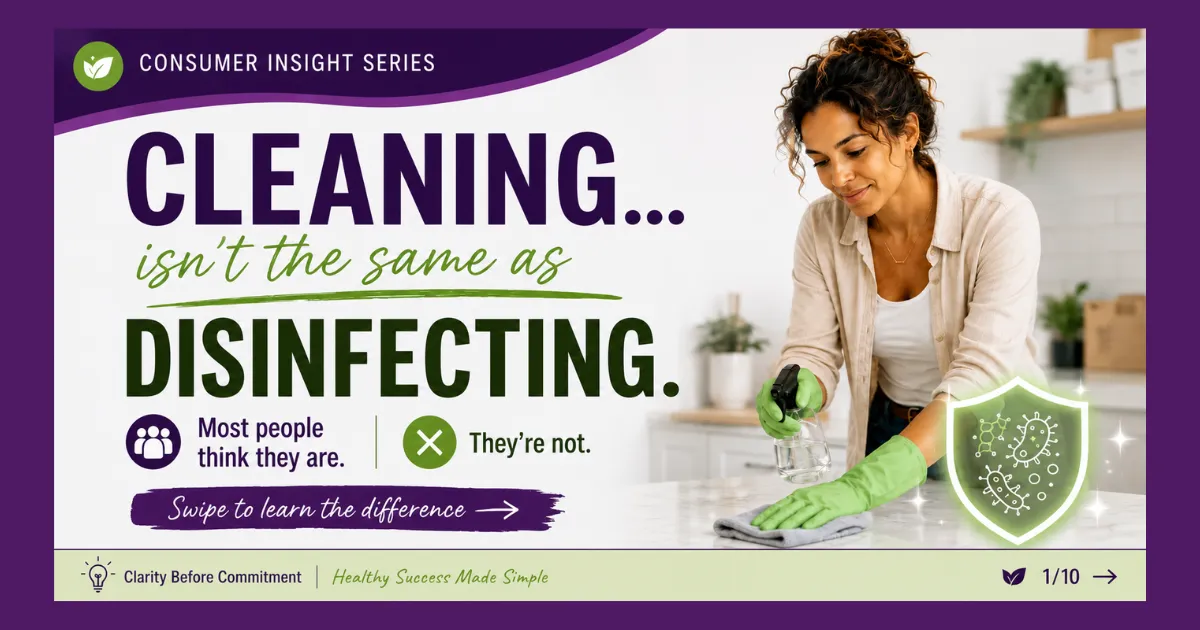
Cleaning Vs Disinfecting
Cleaning vs. Disinfecting: What's the Difference? The Truth About Homemade Cleaners, "Natural" Products, and What Really Keeps Your Home Safe
Can a homemade cleaner disinfect? Is natural always better? What's the difference between cleaning and disinfecting?
These are some of the most common questions people ask—and for good reason.
Household products have become more expensive, and many families are looking for ways to save money. Social media is filled with DIY cleaning recipes and claims that simple household ingredients can replace commercial products.
Some of those ideas can help you clean.
But cleaning and disinfecting arenotthe same thing.
Understanding the difference can help you make better decisions for your home, your budget, and your family's health.
Cleaning vs. Disinfecting: They Have Different Jobs
Many people use these words interchangeably, but they mean very different things.
Cleaning
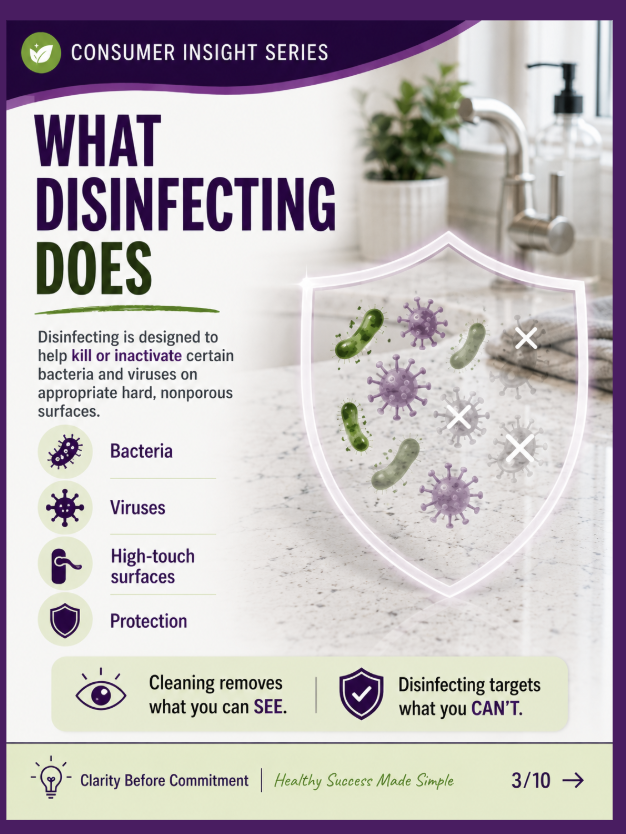
Cleaning removes things you can often see:
Dirt
Dust
Grease
Food residue
Stains
A countertop can look spotless after you've cleaned it.
A floor can shine.
Your bathroom sink can smell fresh.
But none of those things automatically mean harmful bacteria or viruses have been eliminated.
Cleaning removes many germs simply because you're wiping them away—but that's different from killing them.
Disinfecting
Disinfecting has a different purpose.
Disinfectants are designed to kill or inactivate specific bacteria and viruses on hard, nonporous surfaces.
This is especially important:
During cold and flu season
When someone in the home is sick
In kitchens where raw meat is prepared
In bathrooms
On frequently touched surfaces like doorknobs, light switches, and countertops
The best practice is often toclean first, then disinfect if needed.
Removing dirt allows disinfectants to work more effectively.
Why Homemade Cleaning Products Are Becoming So Popular
It's easy to understand why DIY cleaners have become popular.
People want products that are:
Less expensive
Simpler
More environmentally conscious
Safer for their families
Made with familiar ingredients
There are thousands of recipes online combining ingredients like:
Vinegar
Baking soda
Essential oils
Hydrogen peroxide
Castile soap
Lemon juice
Rubbing alcohol
Many of these ingredients can help clean surfaces.
But here's the question most people never ask:
Has this combination actually been tested to prove it disinfects?
Cleaning Doesn't Automatically Mean Disinfecting
A homemade cleaner may remove grease.
It may smell wonderful.
It may leave your counters sparkling.
That still doesn't tell you whether harmful bacteria or viruses have been destroyed.
If your goal is simply removing dirt, many homemade recipes may work well.
If your goal is disinfecting, appearance isn't enough.
Evidence matters.
Why Scientific Testing Matters
Professional disinfectants aren't simply mixtures of ingredients.
They're carefully formulated and tested.
In the United States, disinfectants that claim to kill specific bacteria or viruses must meet strict testing standards before those claims can be made.
Researchers evaluate factors such as:
The exact concentration of active ingredients
Contact time (how long the surface must remain wet)
Different surface types
Stability over time
Consistency from one bottle to the next
Those are things that homemade recipes rarely address.
Without standardized testing, it's impossible to know whether a recipe consistently performs the way people claim.
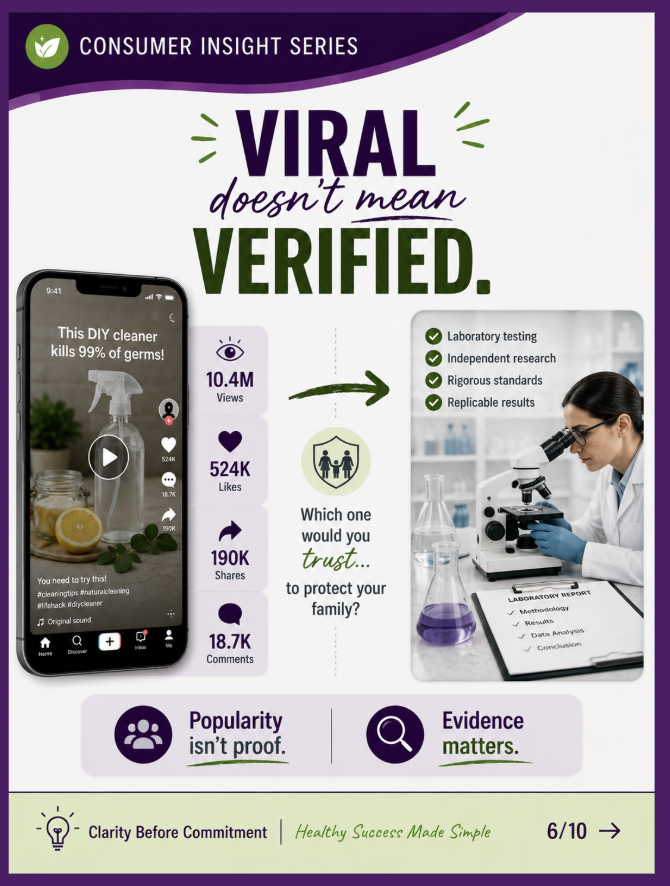
Just Because It's Popular Online Doesn't Make It True
Social media is wonderful for sharing ideas.
It's not always a reliable source for science.
A DIY cleaner may have:
Thousands of shares
Hundreds of positive comments
Five-star reviews
But personal experiences aren't the same as controlled scientific testing.
Without testing, no one really knows:
Whether it kills bacteria
Whether it kills viruses
How long does it remains effective
Whether the ingredients interfere with one another
Whether it's safe to store for weeks or months
Popularity isn't proof.
"Natural" Doesn't Automatically Mean Safe
One of the biggest misconceptions today is that natural always means safer.
It doesn't.
Nature provides many wonderful things.
It also provides some of the world's most dangerous substances.
For example:
Poison ivy is natural.
Cyanide occurs naturally in certain plants and seeds.
Arsenic occurs naturally in some soil and groundwater.
Some wild mushrooms are completely natural—and deadly.
Likewise, many medicines that save lives every day are carefully developed through scientific research.
The better questions aren't:
"Is it natural?"
The better questions are:
Is it safe?
Has it been tested?
Does it actually work?
Evidence should matter more than marketing.
Dangerous Household Cleaning Combinations
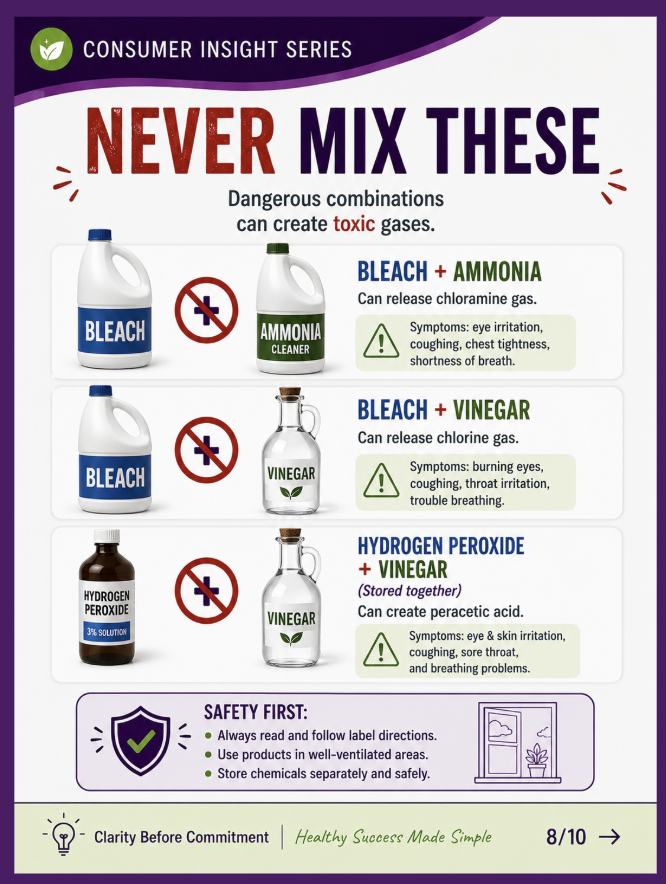
Another reason to be cautious with homemade cleaning recipes is that not all ingredients are safe to mix.
Some combinations can create dangerous gases or harmful chemicals.
Examples include:
Bleach + ammonia can produce toxic chloramine gases.
Bleach + vinegar or other acids can release chlorine gas.
Hydrogen peroxide and vinegar, when mixed or stored together, can form peracetic acid, which can irritate the skin, eyes, and lungs.
Mixing multiple commercial cleaners can also reduce effectiveness or create unexpected chemical reactions.
When it comes to cleaning products, following the manufacturer's directions is almost always the safest approach.
Essential Oils Aren't Automatically Disinfectants
Essential oils are popular for good reason.
Many smell wonderful.
Some have demonstrated antimicrobial properties in laboratory studies.
But having antimicrobial properties isn't the same as being a proven disinfectant for household use.
Factors like concentration, formulation, surface type, and contact time all affect whether a product actually works.
A pleasant scent shouldn't be mistaken for proof that germs have been eliminated.
More Product Doesn't Mean Better Results
Another common misconception is that using more product makes it work better.
Not necessarily.
Too little product may reduce effectiveness.
Too much may:
Leave residue
Damage surfaces
Waste money
Create unnecessary exposure
Professional formulations include directions based on extensive testing—not guesswork.
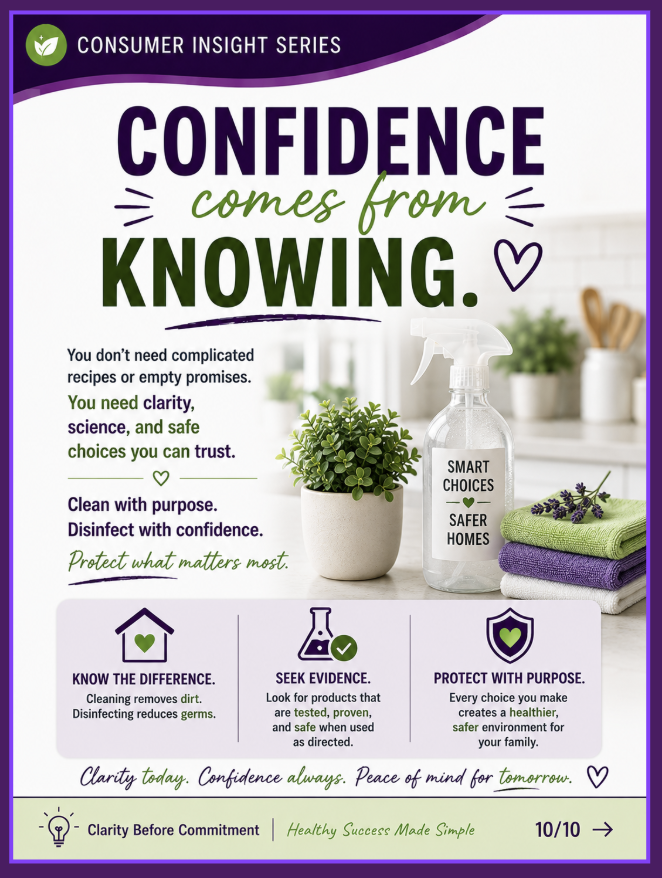
Confidence Comes From Knowing
The goal isn't to make people afraid of homemade cleaners.
Many people are simply trying to save money and create healthier homes.
Those are worthwhile goals.
The key is understanding what you're asking a product to do.
Ask yourself:
Am I trying to remove dirt?
Am I trying to disinfect?
Has this product actually been tested for that purpose?
Am I using it according to its directions?
The more we understand the difference between cleaning and disinfecting, the easier it becomes to make informed decisions.
Not decisions based on trends.
Not decisions based on marketing.
Not decisions based on assumptions.
Decisions based on evidence.
Because confidence doesn't come from simply believing something works.
It comes from knowing why it works.
That's what Clarity Before Commitment is all about.
Frequently Asked Questions
What is the difference between cleaning and disinfecting?
Cleaning removes dirt, grease, dust, and many germs from surfaces. Disinfecting uses products specifically formulated and tested to kill or inactivate certain bacteria and viruses on appropriate surfaces.
Can homemade cleaners disinfect?
Some homemade ingredients may help clean surfaces, and some have antimicrobial properties under certain conditions. However, most DIY recipes have not been scientifically tested to verify that they consistently disinfect household surfaces.
Is vinegar a disinfectant?
Vinegar is a useful household cleaner for some purposes, but it isnotconsidered a registered disinfectant for many disease-causing bacteria and viruses. If disinfection is your goal, use products specifically tested and labeled for that purpose.
Does natural mean safer?
No. Many natural substances can be harmful, while many scientifically developed products are safe when used according to their directions. Safety depends on the product, its ingredients, and how it is used—not simply whether it is natural.
Is it safe to mix household cleaning products?
Generally, no. Certain combinations—such as bleach with ammonia or bleach with vinegar—can create dangerous gases. Always follow the manufacturer's directions and avoid mixing cleaning products unless specifically instructed.
Should I clean before disinfecting?
Yes. Cleaning first removes dirt and debris that can interfere with a disinfectant's ability to work effectively. If disinfection is needed, cleaning first is generally recommended.
Key Takeaways
Cleaning, sanitizing, and disinfecting are not the same. Each serves a different purpose and understanding the difference helps you choose the right product.
A surface can look clean without being disinfected. Removing dirt doesn't necessarily eliminate harmful bacteria or viruses.
Homemade cleaning products may clean well, but most have not been scientifically tested to prove they disinfect.
"Natural" isn't a safety rating. Poison ivy, naturally occurring cyanide, arsenic, and poisonous mushrooms all occur in nature. The better question is whether a product has been proven to be safe and effective.
Mixing household cleaners can be dangerous. Some combinations, such as bleach with ammonia or vinegar, can produce toxic gases.
Making informed decisions starts with evidence, not assumptions. Understanding what a product is designed to do helps protect your family, your home, and your budget.
Continue the Conversation
What influences your decisions most when choosing household cleaning products?
Price?
Ingredients?
Proven effectiveness?
Safety for your family or pets?
Environmental impact?
Or have you ever tried a homemade cleaner that surprised you—for better or worse?
I'd love to hear your experiences and thoughts in the comments. Every conversation helps us become more informed consumers.
Clarity Before Commitment
AtHealthy Success Made Simple, we believe better decisions begin with better information.
Our goal isn't to tell you what to buy—it's to help you ask better questions, understand the facts, and make confident choices that fit your family's needs, health, and budget.
Because when you understandwhysomething works, making the right decision becomes much easier.


