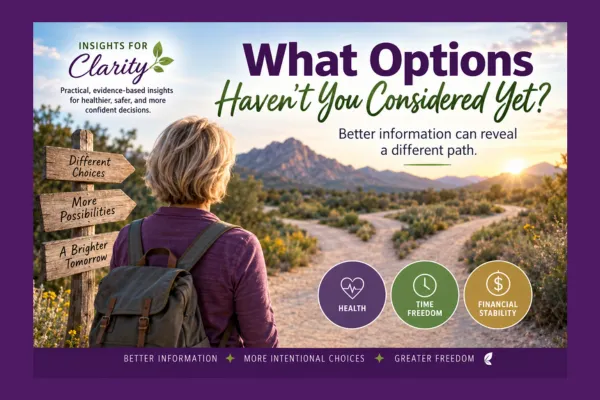
How to Make Better Decisions by Considering More Options
Are You Staying in Your Lane Because It’s Right - Or Because It’s the Only One You Know?
What if the option that could change your outcome isn’t one you’ve considered yet?
Better decisions aren't only about choosing wisely from the options in front of us. They're also about discovering whether better - or simply different - options exist.
Most of us like to believe we consider our options before making an important decision. But do we really?
Sometimes what we call “considering our options” is actually choosing among the two or three possibilities we already know.
😅 We look at the jobs we know exist.
😅 We manage money using the strategies we’ve been taught.
😅 We shop in the places we’ve always shopped.
😅 We approach health through the systems, products, and solutions we know.
😅 We solve business problems using methods we’ve seen other people use.
😅 We organize our time around responsibilities and routines we’ve already accepted.
And because those choices are familiar, they can begin to feel like the choices rather than simply some of the choices.
That distinction matters - because you cannot seriously evaluate an option you don't know exists.
And sometimes the biggest change in an outcome begins not with making a different decision, but with discovering that more decisions were available.
Why Is Considering Alternatives Important When Making Decisions?
Considering alternatives expands the choices you can evaluate before deciding.
When we rely only on familiar solutions, we may overlook entirely different approaches to improving our health, managing our time, creating income, solving business problems, or making everyday consumer decisions.
Better information doesn't guarantee a different decision - But it can reveal choices we didn't know were available.
That distinction matters because education isn't simply about choosing better between Option A and Option B. Sometimes education reveals Option C.
A Story That Made Me Think About Options
I recently read a Chicago Tribune article about Kennedy-King College in Chicago launching a licensed certified professional midwifery associate degree program.
The article describes women who already have connections to maternal care in different ways. One woman currently works as a doula and sees becoming a certified midwife as an opportunity to take her work further. Another prospective student comes from a family that includes midwives, healers, and wellness practitioners.
But something else about the story caught my attention: the program itself creates a pathway that previously wasn't readily available within that community.
Students can complete a six-semester program, prepare for state licensure, and potentially practice in the communities where they live. The program was intentionally located on Chicago's South Side, with access to training - and ultimately maternal healthcare - being part of the objective.
It made me think about something much bigger than midwifery.
👉 What happens when someone discovers an option they didn't previously know was available?
The person's abilities may not have changed overnight.
Their ambition may not have changed.
Their circumstances may not immediately change.
What changed was their awareness of another possible path. And awareness can change everything that follows.
How Familiarity Limits the Options We Consider
From a very young age, we learn how life is generally supposed to work.
😜 Get an education. Find a good job. Work hard. Move up. Save some money. Buy a home if you can. Contribute to retirement. Take care of your health. Eventually retire.
Please note that I'm not saying there is anything inherently wrong with any of that. For many people, it creates a very good life.
The problem comes when a familiar path becomes the only path we think to evaluate.
I've seen this throughout my career and in conversations about business, health, finances, time and life.
When people want to earn more money, for example, their first thoughts are often:
😩 Can I get a raise?
😩 Can I get promoted?
😩 Should I change companies?
😩 Can I work additional hours?
😩 Should I find a second job?
Those are all legitimate options. But notice something:
They exist primarily within the same income model: exchanging skills and time for compensation.
What other income models exist?
That question doesn't mean someone should quit a job, start a traditional business, buy real estate, become an investor, begin consulting, or pursue any particular alternative.
It simply means those possibilities deserve to exist on the decision map before someone decides which path makes sense.
Exploring an option is not the same as choosing it.
Sometimes we reject possibilities before we've even learned enough about them to make an informed decision.
Financial Literacy Should Include How We Create Income
We've talked a lot in recent years about financial literacy. Usually that conversation includes budgeting, debt, saving, emergency funds, insurance, investing, and retirement.
All are important. But there's another part of financial education that deserves more attention:
How do we create the income we're trying so hard to manage?
Learning to manage $50,000 more effectively is financial education.
So is understanding how that $50,000 is generated - and whether there are realistic ways to increase it, diversify it, or make some portion of it less dependent upon the number of hours available in a day.
Those are different questions.
Consider someone who has already reduced unnecessary expenses, created a budget, and became disciplined about spending.
Eventually, there is only so much left to cut.
You cannot budget your way out of every income problem.
At that point, increasing or diversifying income becomes part of the financial conversation too.
👉 That might mean advancing within a career.
👉 It might mean developing a new skill.
👉 It could mean consulting, freelancing, investing or owning a business.
👉 It might include building a source of repeat income that doesn't require starting at zero again every month.
The right answer will be different for different people. The point isn't that everyone should create another source of income.
The point is that income creation belongs in the financial education conversation alongside income management.
You can't evaluate possibilities no one ever explained to you.
How Better Information Can Improve Health Decisions
We do something very similar with health and wellness.
Suppose someone decides they want healthier products in their home.
The first instinct may be to visit the same grocery store, big-box retailer, or online marketplace they already use and look for products labeled “natural,” “clean,” “healthy,” or “better for you.”
That's a perfectly reasonable place to begin. But it is still operating within a familiar model.
🤔 What other questions might be worth asking?
🤔 Who actually manufactures the product?
🤔 What ingredients does it contain—and why?
🤔 If it's a supplement, what forms of the nutrients are being used?
🤔 How much of each ingredient is actually present?
🤔 What evidence supports the claims being made?
🤔 How fresh is the product?
🤔 What does it cost per use rather than simply per container?
🤔 Could buying through a different distribution model change the price, freshness, transparency, or overall value?
Suddenly the decision isn't simply: Which product should I buy?
It becomes: What should I know before deciding what - and where - to buy?
That's a much more useful question.
Health decisions aren't improved simply by having more products to choose from.
🔥They improve when you have better information to evaluate those choices.
Are You Managing Your Time - or Questioning What Consumes It?
Time has its own default lane.
➡️ We're busy, so we buy another planner.
➡️ We download another productivity app.
➡️ We reorganize the calendar.
➡️ We wake up earlier.
➡️ We multitask.
➡️ We try to squeeze more into the same 24 hours.
Sometimes those strategies work. But what if the bigger question isn't:
How do I fit more into my schedule?
What if it's:
Why does my life require this much of my time in the first place?
That's a very different conversation.
😳 Perhaps something can be automated.
😳 Perhaps a responsibility can be eliminated or delegated.
😳 Perhaps there's a different way to shop, work, or earn income.
😳 Perhaps something that has always been done a certain way no longer needs to be.
😳 Perhaps the objective shouldn't be becoming more efficient at being overwhelmed.
Sometimes greater time freedom begins with recognizing that a system we've accepted as normal isn't the only system available.
Why Don't We Look for More Alternatives?
Sometimes because we simply don't know they're there.
But that's not the only reason. Familiarity feels safer.
We've accumulated experience in our lane. We understand the terminology. We know the expectations. We may even know what happens when something goes wrong.
😳 An unfamiliar option introduces uncertainty. And uncertainty can easily be interpreted as risk.
We also have a very human tendency to look for solutions inside the framework we've already accepted.
➡️ If a product is too expensive, we look for a cheaper version at another familiar retailer.
➡️ If our schedule is overwhelming, we look for a better calendar.
➡️ If our income isn't enough, we look for a better-paying job.
➡️ If our business isn't growing, we look for another marketing tactic.
➡️ If we're concerned about our health, we may look for another version of the same type of solution we've always used.
Sometimes that's exactly the right answer. But sometimes we're trying to optimize a model that isn't capable of producing the outcome we actually want.
That's when a different question becomes useful:
What if the problem isn't how I'm doing this? What if I should also be asking whether there's another way to do it?
Sometimes We Need to Compare Models, Not Just Products
Consumers don't always consider this.
We tend to compare choices within a model.
🤔 Brand A versus Brand B.
🤔 Store A versus Store B.
🤔 Job A versus Job B.
🤔 Investment A versus Investment B.
But sometimes the more interesting comparison is between the models behind those choices.
Buying a less expensive product from another retailer is one alternative.
Buying through an entirely different distribution model is another.
Finding another salaried position is one alternative.
Developing another source of income is another.
Choosing another supplement is one alternative.
Learning more about manufacturing, sourcing, nutrient forms, freshness, and evidence before choosing any supplement is another.
A different choice within the same model may improve the outcome. A different model may change the possibilities entirely.
Neither is automatically better - but let's be clear that they're not the same decision.
Does Having More Options Lead to Better Decisions?
Not necessarily.
More options only improve decision-making when we have enough reliable information to evaluate the benefits, risks, and trade-offs.
Discovering alternatives doesn't mean chasing every alternative.
Quite the opposite.
More options require more discernment, not less.
🙄 A different career path may require education, time, or money that doesn't make sense for you.
🙄 A different financial strategy may involve risks you aren't comfortable taking.
🙄 A different health product may have wonderful marketing but little evidence behind it.
🙄 A different shopping model may not offer the products or value you're looking for.
🙄 A different business or income opportunity may sound exciting until you understand the expenses, compensation structure, time requirements, customer demand, and likelihood of creating the outcome you want.
Just because another lane exists doesn't mean you should take it.
It means you should understand it well enough to make that decision intentionally.
That's clarity.
Four Questions to Ask Before Making an Important Decision
Before deciding what to do next, consider asking:
1. What outcome am I actually trying to create?
It's difficult to evaluate options if you're unclear about the result you want.
2. What options do I already know about?
Write them down. Seeing them together often reveals whether they are genuinely different alternatives or simply variations of the same solution.
3. What alternatives haven't I investigated?
This may require research, asking better questions, or talking with people who have experience outside your normal circle.
4. What information would allow me to compare those choices fairly?
Consider cost, time, risk, evidence, flexibility, sustainability, long-term impact, and the tradeoffs involved.
The goal isn't to find the option with no downside. That option probably doesn't exist.
The goal is to understand the alternatives well enough to decide which tradeoffs make sense for the outcome you're trying to create.
Staying in Your Lane Can Be a Great Decision
There is nothing wrong with deciding to stay exactly where you are.
In fact, after examining the alternatives, you may have even more confidence in your current choice.
That's clarity.
The difference is between: “This is what I've always done.”
and “I've looked at the reasonable alternatives, understand the tradeoffs, and this is still the choice that makes the most sense for me.”
Those statements may produce exactly the same action.
But they represent very different decision-making:
One is based primarily on familiarity. The other is based on knowledge and intentional choice.
Knowledge Changes More Than Decisions
We often think of education as something that makes us better at choosing.
👉 Learn more about nutrition so you can make better health decisions.
👉 Learn about money so you can make better financial decisions.
👉 Learn about business so you can make better business decisions.
👉 Learn about products so you can become a more informed consumer.
All true. But education can do something else.
It can reveal possibilities that weren't previously on your decision map at all.
That's where the relationship between knowledge, clarity, and choice becomes especially important.
KNOWLEDGE + CLARITY + CHOICE = FREEDOMS
😱 More knowledge doesn't guarantee a better life.
😱 More options don't guarantee better decisions.
😱 And freedom doesn't mean pursuing every possibility.
But having good information, understanding the trade-offs, and knowing that alternatives exist gives us the opportunity to make more intentional decisions about three things that affect almost every part of life:
HEALTH • TIME • MONEY
And those decisions are interconnected.
👉 How we earn money affects our time.
👉 How we use our time can affect our health.
👉 Our health can affect our finances and how we spend our time.
👉 Our financial decisions influence the choices available to us today - and potentially the choices we'll have years from now.
They aren't separate conversations nearly as often as we pretend they are.
Before Your Next Important Decision, Ask One More Question
We spend a lot of time asking:
What should I do?
Maybe there's another question that should come first:
What options haven't I considered yet?
Not because the answer will necessarily change your decision - but because it might change the choices you're deciding between.
😎 That could apply to your career. Your income. Your health. Your business. Your education. How you spend your time. Where and how you buy the things you use every day. How you prepare financially for the future. How you create greater flexibility for yourself and your family.
The objective isn't to live constantly searching for something different.
It's to avoid mistaking familiarity for inevitability.
Sometimes the answer really is to keep going in the lane you're already in. And sometimes the information you didn't have yesterday reveals an entirely different road.
Education isn't only about learning how to make better decisions. Sometimes education changes the decisions that are available to us.
That's just one reason clarity matters.
Better information creates greater clarity. Greater clarity makes intentional choices possible.
And more intentional choices can create greater freedom and control over the life we're building.
One Last Question
Think about one area of your life where you'd like a different outcome.
Have you explored genuinely different alternatives - or mostly different versions of the same solution?
Then ask yourself: What would I need to learn to discover whether there are other options?
And perhaps the most interesting question of all: When was the last time you discovered an option and thought, “I didn't even know that was possible”?
Frequently Asked Questions About Making Better, More Informed Decisions
How can I make better decisions when I don't know all my options?
Start by defining the outcome you want before evaluating solutions. Then identify the options you already know and deliberately look outside your usual sources for alternatives. You don't need to discover every possible choice. The goal is to understand enough reasonable alternatives to avoid making an important decision based solely on familiarity.
Why is it important to consider alternatives before making a decision?
Considering alternatives lets you compare different ways to achieve the same outcome. Without that comparison, it's easy to assume the familiar solution is the best - or only - solution. Exploring alternatives can reveal differences in cost, risk, time, flexibility, evidence, sustainability, and long-term impact.
Does having more choices lead to better decisions?
Not automatically. More choices are valuable only when you have reliable information and clear criteria for evaluating them. Too many poorly understood choices can actually make decision-making harder. The objective isn't to collect the most options; it's to identify the most relevant ones and understand their tradeoffs.
What is informed decision-making?
Informed decision-making means using relevant, reliable information to understand your available choices, their potential benefits and drawbacks, and how well each aligns with the outcome you want. It also means recognizing what you don't yet know before making a commitment.
How does financial literacy affect the choices available to us?
Financial literacy is often associated with budgeting, saving, debt, insurance, and investing, but understanding how income is created is important too. Learning about different ways to earn, increase, or diversify income can expand the financial choices someone is able to evaluate. Financial education is not only about managing the money you have; it can also include understanding different ways to generate money.
How can better information improve health and wellness decisions?
Better information allows consumers to evaluate more than advertising claims or front-of-package language. Depending on the product, useful questions may include who manufactures it, what ingredients and amounts it contains, what evidence supports its claims, how it is produced, its freshness or stability, and its actual cost per use. Better health decisions begin with knowing which questions are worth asking.
Why do people tend to choose familiar options?
Familiar options often feel less risky because we understand them. We know how they work, what they cost and what to expect. Unfamiliar choices introduce uncertainty, and uncertainty can feel uncomfortable. Familiarity can be useful, but it shouldn't automatically be mistaken for evidence that an option is better.
What's the difference between comparing products and comparing models?
Comparing products means evaluating choices within essentially the same system - for example, comparing two brands sold through traditional retail. Comparing models goes a level deeper and examines whether a different way of buying, earning, working, or solving the problem could produce a different outcome. Sometimes changing the product is enough. Other times, the underlying model is worth evaluating too.
How do health, time and money affect one another?
Health, time and money are interconnected. How we earn money affects how we use our time. Time constraints can influence food, exercise, shopping and other health decisions. Health challenges can affect both finances and available time. Financial resources can also expand or restrict future choices. A decision in one area can therefore create consequences - or opportunities - in the others.
What questions should I ask before making an important decision?
A simple starting framework is:
What outcome am I actually trying to create?
What options do I already know about?
What reasonable alternatives haven't I investigated?
What information do I need to compare those choices fairly?
Then consider the cost, time, risk, evidence, flexibility, sustainability, and short- and long-term tradeoffs of each realistic option.
The objective isn't to eliminate every risk or find a perfect choice.
It's to make sure the decision you're making is based on knowledge, clarity, and choice - not simply familiarity.


